
Jo Daviess County Court Records After a Jail Arrest
After a Jo Daviess County jail arrest, the records split across three offices. The sheriff holds the arrest and booking record. The Jo Daviess County State's Attorney decides the charges and prosecutes the case. The Circuit Clerk keeps the court file. The State's Attorney is Chris Allendorf, and the office prosecutes violations of Illinois criminal statutes and county ordinances. So the court record after an arrest is really the prosecutor's charge filed into the clerk's case file.
It helps to keep the two sides apart. The arrest and booking side covers who was taken into custody and when. For that, see the jail inmate records page for the roster channels and the jail mugshots page for booking photos. The court record side covers the charges the prosecutor filed and how the case moves. The State's Attorney page, captured below, sets out the prosecutor's role.
The State's Attorney page describes the office that files charges after an arrest.
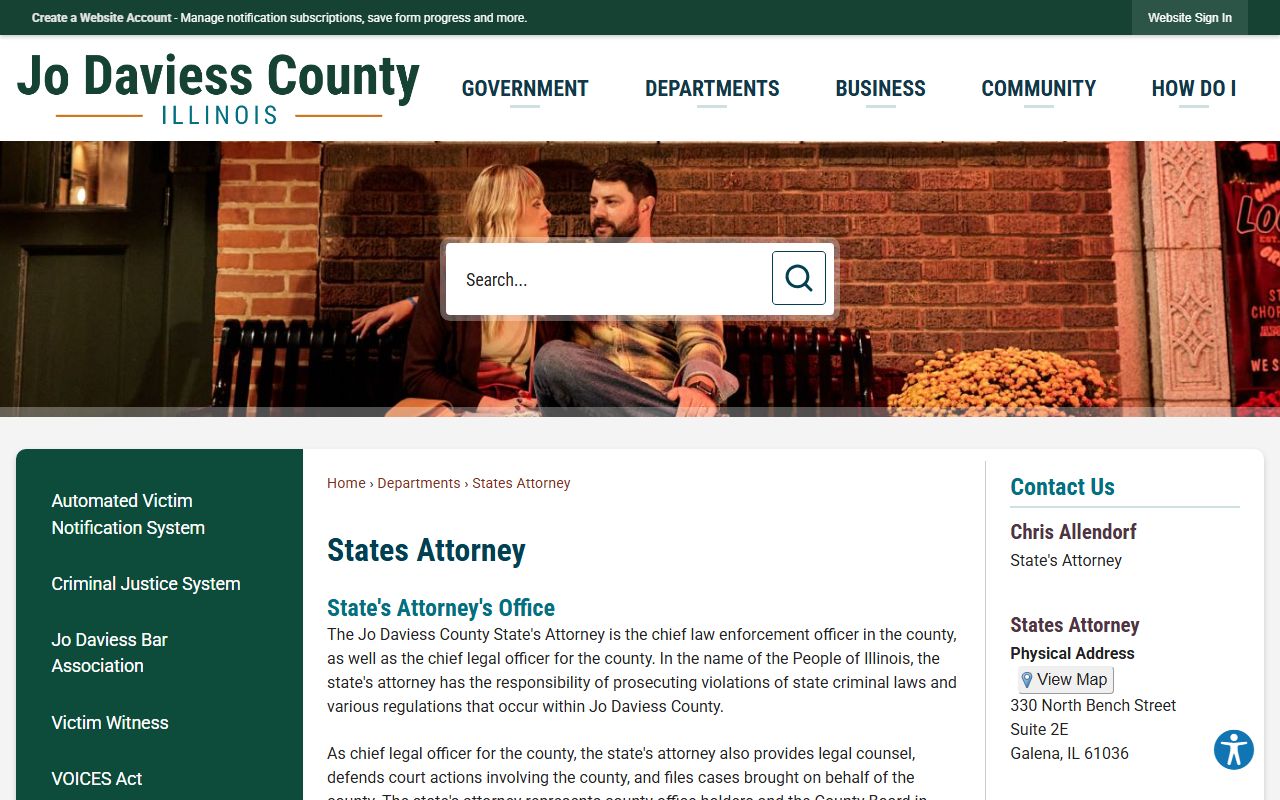
That office turns a booking charge into the formal court charge, which is the heart of the court record after an arrest.
The prosecutor's office is small but full-time. It is led by the State's Attorney and includes two assistant prosecutors, an office manager, an executive secretary, and a victim and witness coordinator. The office is on call around the clock for local law enforcement, though its public hours run Monday through Friday, 8 am to 4 pm. The victim and witness coordinator pairs with Illinois VINE for custody and case alerts.
How to Find Jo Daviess County Court Records After an Arrest
The county links its court-record search to Judici. The Circuit Clerk and online-services pages point to Judici for "Search Court Records." Judici is vendor-hosted and states it is operated by Judici.com, not a court, so its links do not mean a court endorses it. During research the case-search page returned an hCaptcha screen, so exact field labels could not be confirmed. The county "View" page does say court records can be searched by name or case number.
- Open the Jo Daviess County Judici case search.
- Search by defendant name or case number.
- Open the case and read the charge list.
- Check each charge for its level and current status.
If Judici does not show the record or the captcha blocks access, contact the Circuit Clerk, Kathy Phillips, at 815-777-0037, or request copies by mail, email, fax, or in person. The Circuit Clerk posting states the office is not subject to FOIA, so court copies follow court-copy rules, listed at 25 cents per page. The Judici case-search page is captured below.
Judici is the official-linked channel for Jo Daviess court records, though its access can be limited by the captcha and by case type.
Virtual Court and the 15th Judicial Circuit
The Jo Daviess County Courthouse sits in the 15th Judicial Circuit and the 4th District. Most court business runs through the Circuit Clerk, whose office is captured below. Beyond the Judici case search, the courts use two state systems for documents. The eFileIL portal is for filing, not general public criminal search, and re:SearchIL is a document repository with access controlled by user and case type under the state remote-access policy. So a member of the public usually searches Judici by name or case number rather than those filing tools.
The Circuit Clerk page links to court records, payments, e-filing, and virtual court.
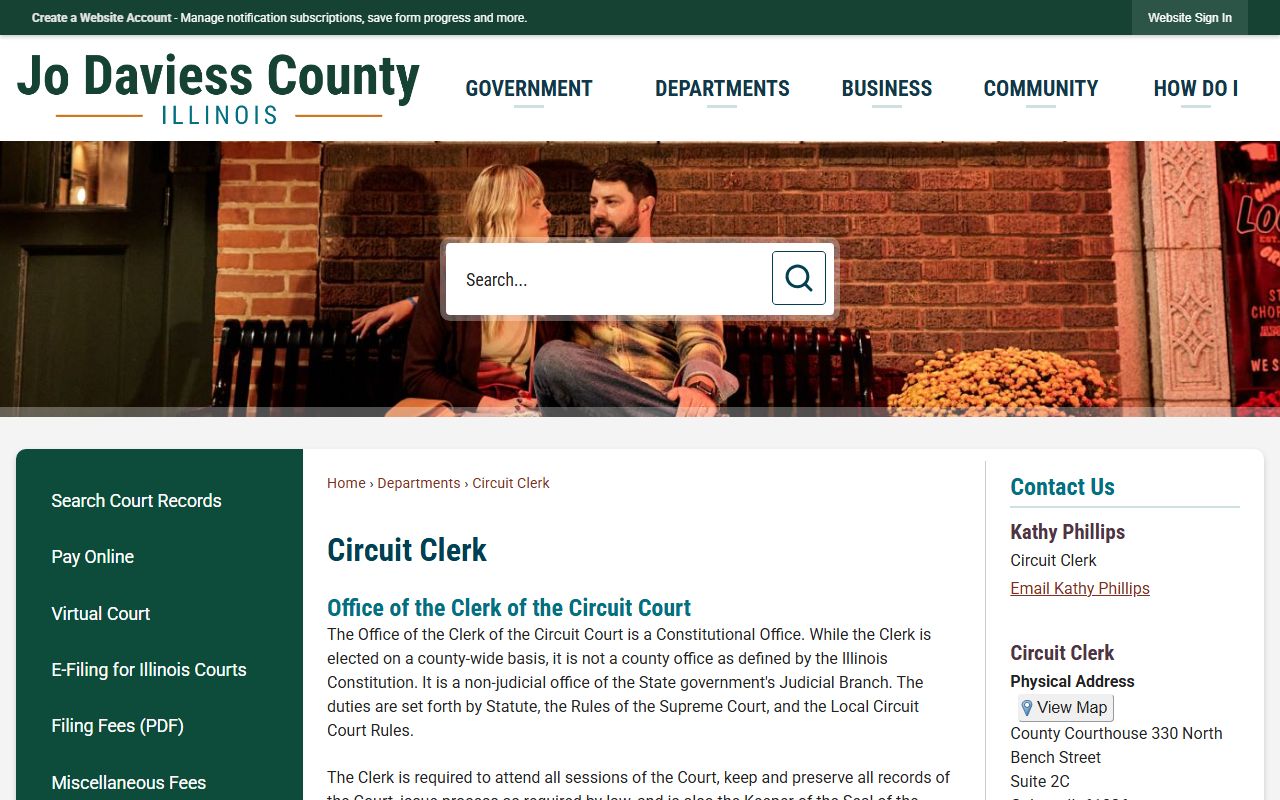
Remote hearings matter for anyone tracking a case after an arrest. Since January 1, 2023, the county notes that most cases can be heard in person or by Zoom, and a reader should check the administrative order to learn whether a personal appearance is required. The Circuit Clerk also offers a mobile app, the Jo Daviess Circuit Clerk IL app, built for court communication rather than jail or inmate lookup. Verify hearing requirements with the Circuit Clerk or the court order, since remote appearance is not allowed for every case type.
How Charges Get Filed After an Arrest: Complaint, Information, and Indictment
The court record begins with a charging document. Booking happens at the jail, then the case opens when the prosecutor files one of three documents. A complaint can start a case, often for lower-level offenses. An information is a prosecutor-filed charge used in many cases. An indictment comes from a grand jury for serious felonies. Each one opens a court file.
| Complaint | Information | Indictment | |
|---|---|---|---|
| Filed By | Officer or prosecutor | Prosecutor | Grand jury |
| Common For | Misdemeanors | Many felonies | Serious felonies |
| Starts | The case | The case | The case |
The filed charge can differ from the booking charge. A booking charge is the officer's arrest allegation. The court charge is the prosecutor's formal decision, which can be the same, reduced, raised, or replaced.
Charge Status in Jo Daviess County Court Records
Charges change as a case moves. A charge can be amended, reduced, added, dropped, or dismissed. The court record tracks each shift, which is why the booking charge on day one may not match the charge at the end. The terms below show up often in a case file.
| Status | What It Means |
|---|---|
| Pending | The charge is filed and the case is still open. |
| Amended / Reduced | The charge was changed or lowered as the case moved. |
| Dismissed | The charge was dropped and is no longer pursued. |
| Nolle Prosequi | The prosecutor chose not to pursue the charge. |
Older, sealed, juvenile, or restricted cases may not appear in a public search. Access can differ by case type, since traffic, misdemeanor, felony, and juvenile files follow different rules. A recent arrest can also lag the court record, because charges may be filed later, filed under a different case type, or not filed at all. So a missing case does not always mean a missing arrest.
Bond and Release After a Jo Daviess County Arrest
Illinois changed how release works. The Pretrial Fairness Act ended monetary bail for ordinary pretrial release on September 18, 2023. Courts now set the least restrictive conditions under 725 ILCS 5/110-5, and a prosecutor must file a verified petition under 725 ILCS 5/110-6.1 to seek detention. So the old cash-bail model no longer drives most new cases. The county still posts a $25 bond fee and JailATM bond instructions, which can apply to fees or legacy situations.
- Cash Bond
- Largely replaced for new cases since the 2023 reform.
- Surety Bond
- A third party guarantees appearance; rare under the new framework.
- Pretrial Release
- Release under court-set conditions rather than a cash payment.
- No-Bond Hold
- Detention after a verified petition, or a hold from another agency.
Payment alone does not always free a person. A detainer, a hold from another county, parole status, or federal interest can keep someone in custody even when a local matter is resolved. Because Illinois no longer runs a normal cash-bail system for new cases, do not assume a commercial bail bond is the path to release; the court order and any holds control the outcome.
Warrants That Lead to a Jo Daviess County Arrest
A warrant can be the reason for a booking. An arrest warrant is judge-authorized on probable cause. A bench warrant often issues for a failure to appear. No public active-warrant list for Jo Daviess County was located, so warrant questions route to the sheriff, the Circuit Clerk, and the court that issued the warrant. The sheriff page does state the office executes writs and warrants.
The sheriff also runs tip channels, which are not warrant-search tools. The Submit a Tip form, captured below, takes suspect, vehicle, and crime details. Crime Stoppers for Dubuque and Jo Daviess Counties takes anonymous tips at 563-588-0714 or 800-747-0117 using a caller code number. Do not use a tip form to clear your own warrant; route that to the court, clerk, attorney, or sheriff.
The Sheriff's Office Submit a Tip form is a tip channel, not a warrant database.
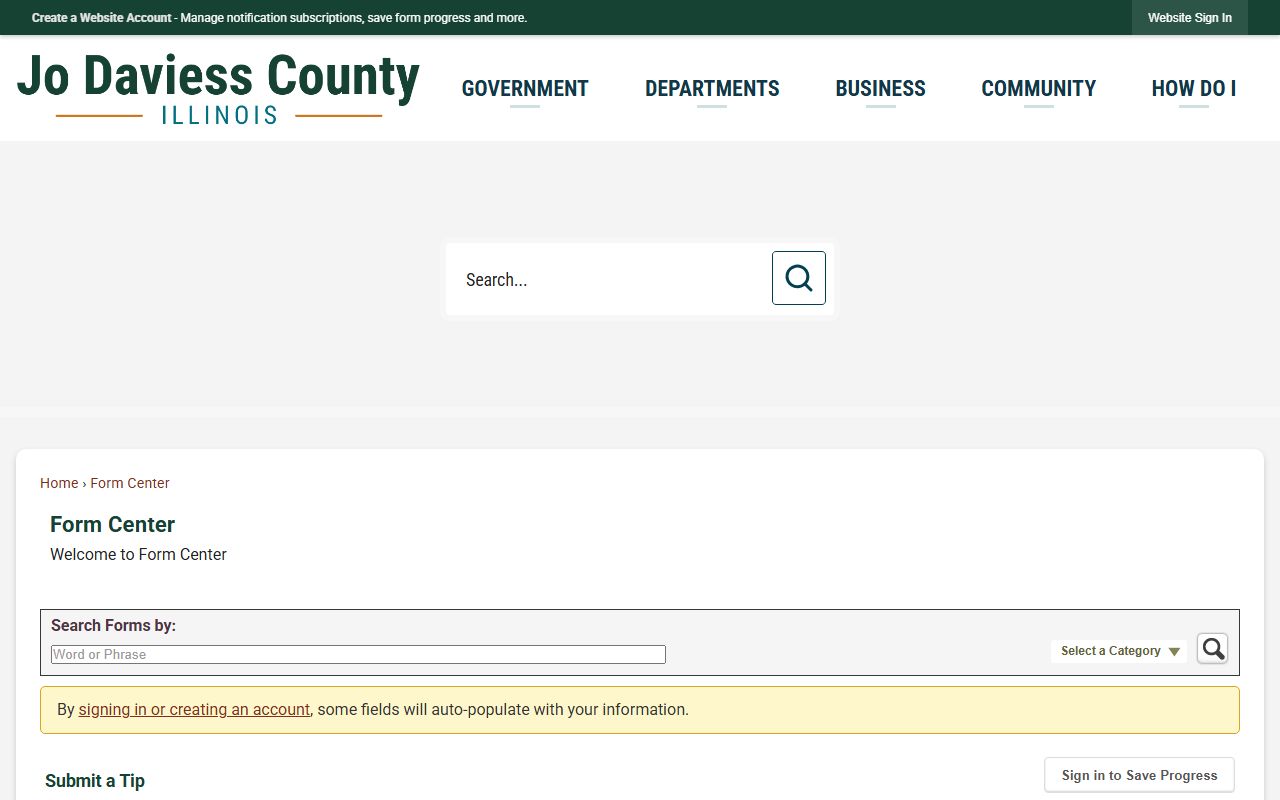
The form is for reporting crime tips, so it sits apart from the court record search and from any warrant resolution.
Charges vs. Convictions in the Court Record
An arrest and a charge are not a conviction. A charge is an accusation that opens the court record. A conviction is the outcome after a plea or a verdict. Many charges end in dismissal, reduction, or acquittal, so a pending charge proves nothing about guilt.
| Charge | Conviction | |
|---|---|---|
| Stage | Accusation | Verdict or plea |
| Burden of Proof | Probable cause | Beyond a reasonable doubt |
| Public Record | Yes | Yes |
Sealed vs. Expunged Records After a Jo Daviess County Arrest
Illinois lets people clear qualifying records. Sealing keeps a record but limits public access without a court order. Expungement removes or destroys a qualifying record. The rules sit in the Criminal Identification Act, 20 ILCS 2630/5.2, and the Illinois Courts publish approved forms. This is the proper route to address an old arrest record, not a private removal service.
| Sealed | Expunged | |
|---|---|---|
| Visibility | Hidden from most public access | Destroyed or treated as never filed |
| Law Enforcement | Limited access | Very limited access |
| Eligibility | Set by 20 ILCS 2630/5.2 | Set by 20 ILCS 2630/5.2 |
Use the Illinois Courts expungement and sealing forms to start, rather than any pay-to-remove offer.
Background Check Considerations
A casual court-record lookup is not a background check. A regulated background check follows the Fair Credit Reporting Act and runs through a licensed agency. Court records viewed for personal information do not meet that standard, and they should not be used to make hiring, housing, lending, or insurance decisions.
Important: This is a private reference site, not a consumer reporting agency under the FCRA, and its content may not be used for any FCRA-covered decision.
Restricted Court Records After an Arrest in Jo Daviess County
Some court records after an arrest stay out of public view. Juvenile cases carry confidentiality. Sealed and expunged charges drop from public search. Dismissed charges may still be withheld in certain settings, and an active investigation can limit release. The Illinois Courts directory lists the Jo Daviess County Courthouse, captured below, with hours of 8:00 am to 4:00 pm and on-site court resources.
The Illinois Courts page for the Jo Daviess County Courthouse lists hours, parking, and accessibility.
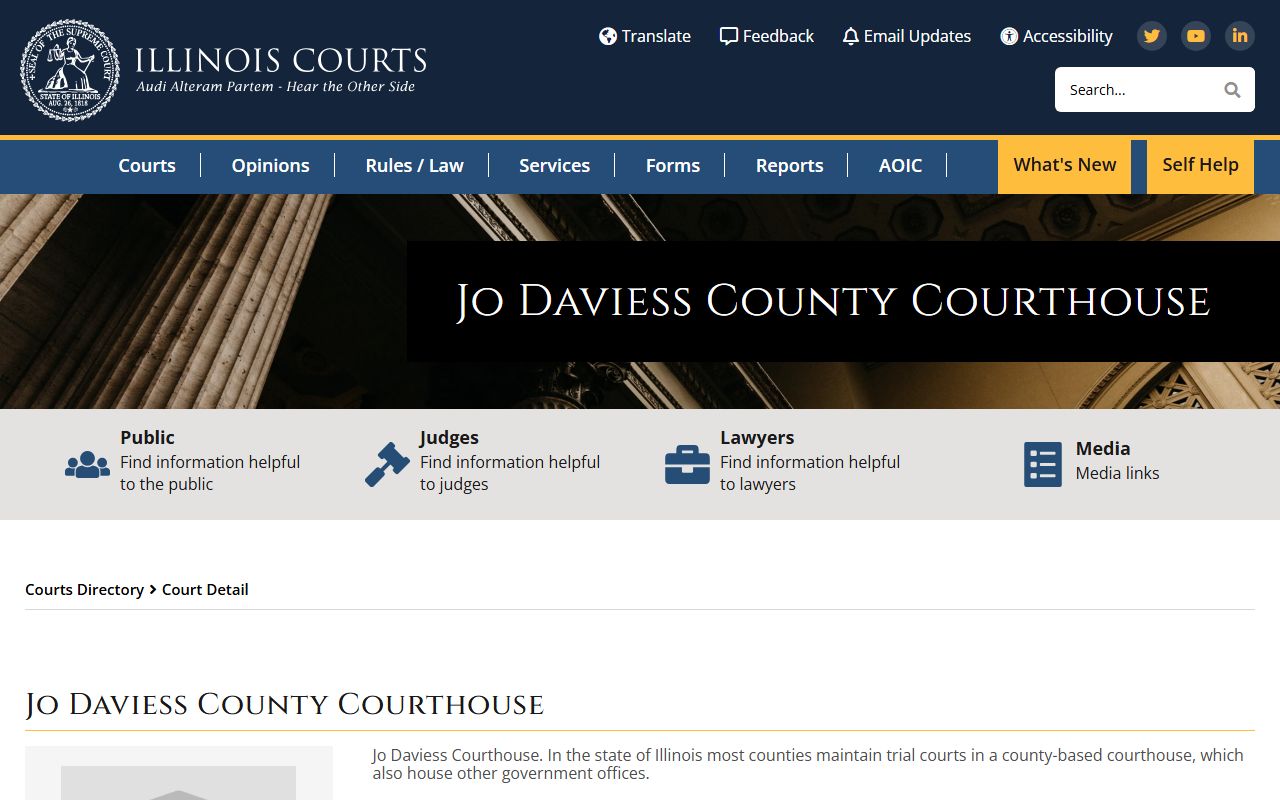
The courthouse page also notes an e-filing kiosk, a law library, interpreters on request, and remote-hearing resources for court business.